
Waist-to-Hip Ratio Calculator
Accurately assess your body composition and cardiovascular health risk based on WHO guidelines. The ultimate free tool for understanding visceral fat distribution.
Waist-to-Hip Ratio Calculator
Welcome! I am the Waist-to-Hip Ratio Calculator, a dedicated digital tool designed to help you look beyond the scale and understand your true body composition and health risk. My goal is to provide you with clear, science-based insights into your fat distribution, specifically visceral fat, which is a critical indicator of cardiovascular and metabolic health. Whether you’re tracking your fitness progress, assessing your health risks, or simply curious about your body shape classification, I’m here to make the complex science of anthropometrics simple, accessible, and actionable.
The Comprehensive Guide to the Waist-to-Hip Ratio Calculator: Mastering Body Composition, Visceral Fat, and Health Risk Assessment
In the intricate landscape of preventive medicine, sports science, and longevity research, understanding the precise mechanics of body fat distribution is paramount to achieving optimal metabolic health. A waist-to-hip ratio (WHR) calculator serves as an indispensable digital utility designed to instantly compute your body shape classification and cardiovascular risk based on a sophisticated algorithm incorporating waist and hip circumference. Whether you are an athlete tracking body composition changes, a health-conscious individual monitoring visceral fat, or someone simply curious about your health risk profile, utilizing a reliable WHR estimator guarantees mathematical precision and strategic foresight. This exhaustive guide will explore the physiological, mathematical, and strategic dimensions of waist-to-hip ratio calculations, establishing why this metric is the cornerstone of modern health management.
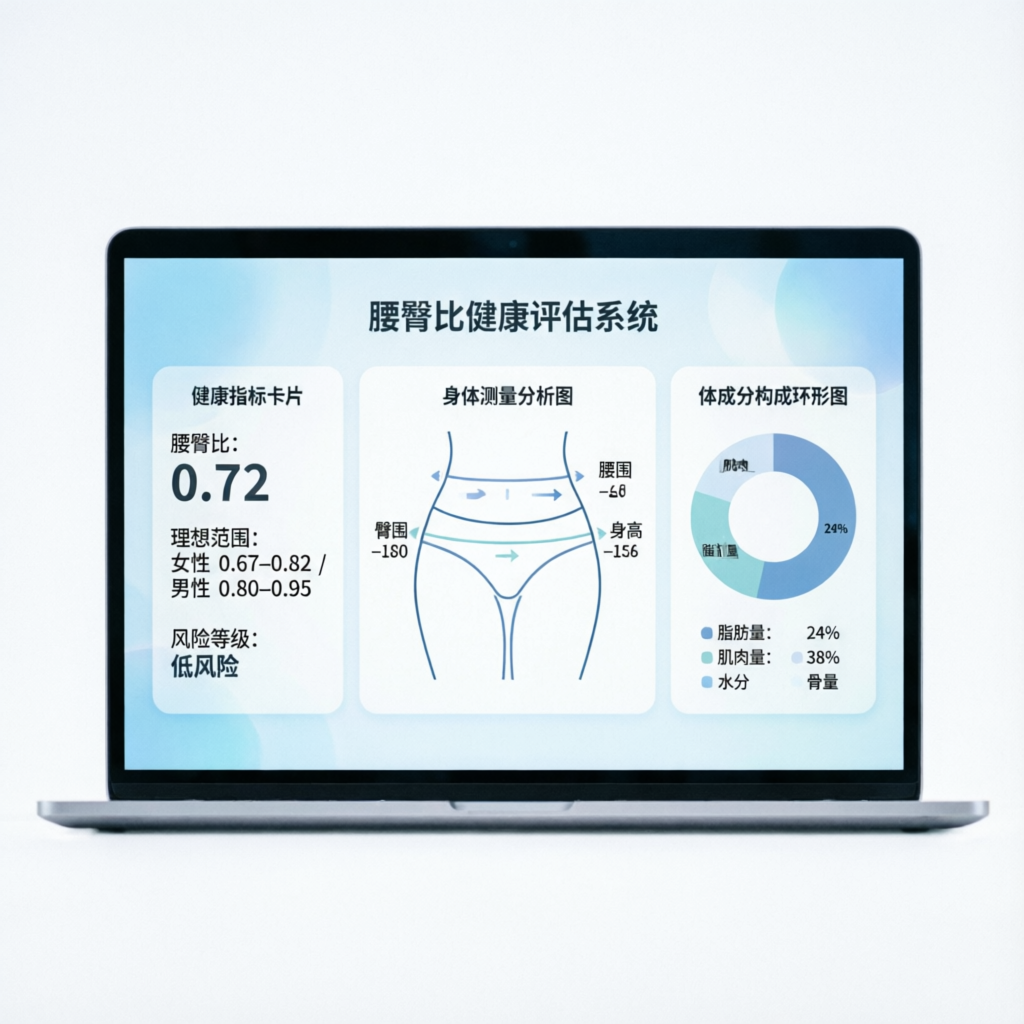
What is Waist-to-Hip Ratio and Why is it Better Than BMI?
Body Mass Index (BMI) is a simple calculation of weight relative to height. While useful for population-level studies, BMI fails to distinguish between muscle mass and fat mass, and more importantly, it completely ignores where that fat is stored. Two people can have the exact same BMI, but one might carry their weight around their hips and thighs (subcutaneous fat, generally lower risk), while the other carries it around their abdomen (visceral fat, high risk).
Waist-to-Hip Ratio (WHR) solves this problem. By dividing your waist circumference by your hip circumference, WHR provides a direct measure of central adiposity (belly fat). This is crucial because visceral fat—the fat stored deep inside the abdomen around organs like the liver, pancreas, and intestines—is highly metabolically active. It releases inflammatory cytokines and free fatty acids directly into the portal vein, driving insulin resistance, dyslipidemia, and cardiovascular disease. WHR is widely considered by endocrinologists and cardiologists to be a superior predictor of heart disease, type 2 diabetes, and all-cause mortality compared to BMI alone.
The Science Behind the Calculation: WHO Guidelines
The logic driving our waist-to-hip ratio calculator is rooted in decades of epidemiological research, most notably the landmark INTERHEART study and guidelines established by the World Health Organization (WHO). The calculation follows a rigorous, multi-step process to ensure your health risk estimate is both effective and physiologically sound.
1. Measuring the Waist
The waist circumference should be measured at the midpoint between the lower margin of the last palpable rib and the top of the iliac crest (hip bone). In practical terms, this is usually at the level of the navel (belly button). The measurement should be taken at the end of a normal expiration, without sucking in the stomach.
2. Measuring the Hips
The hip circumference is measured around the widest portion of the buttocks, ensuring the tape measure is parallel to the floor. This measurement captures the gluteal muscle and subcutaneous fat mass in the lower body.
3. Calculating the Ratio
The formula is straightforward: WHR = Waist Circumference / Hip Circumference. Because it is a ratio, the units (inches or centimeters) cancel out, making the result universally applicable regardless of the measurement system used.
Health Risk Categories by Gender
Because men and women naturally store fat differently due to hormonal influences (estrogen promotes gluteofemoral storage in women, while testosterone promotes abdominal storage in men), the WHO has established gender-specific risk thresholds:
- Men: Low Risk (< 0.90), Moderate Risk (0.90 – 0.99), High Risk (≥ 1.0).
- Women: Low Risk (< 0.80), Moderate Risk (0.80 – 0.84), High Risk (≥ 0.85).
Our calculator seamlessly applies these thresholds, instantly categorizing your result and providing actionable insights into your cardiovascular and metabolic health profile.
How to Use This Free Waist-to-Hip Ratio Calculator
Our online waist-to-hip ratio calculator is engineered for maximum usability, speed, and accuracy. Follow these simple steps to generate your personalized body composition analysis:
1️⃣ Select Your Gender: This adjusts the risk thresholds to match WHO clinical guidelines for men and women.
2️⃣ Choose Your Measurement Unit: Select Centimeters (cm) or Inches (in) based on your regional preference or measuring tape.
3️⃣ Enter Your Waist Circumference: Measure around your navel at the end of a normal breath. Do not suck in your stomach.
4️⃣ Enter Your Hip Circumference: Measure around the widest part of your buttocks/hips, keeping the tape parallel to the floor.
5️ Click “Calculate WHR”: Instantly view your ratio, your health risk category, your body shape classification, and a visual chart comparing your result to the risk thresholds.
Real-World Examples of WHR Calculations
To illustrate the practical application of a waist-to-hip ratio calculator, consider the following scenarios representing different body compositions:
A 35-year-old female, waist circumference of 76 cm, hip circumference of 100 cm.
Calculation: 76 / 100 = 0.76.
Insight: Her WHR is well below the 0.80 threshold for women, placing her in the “Low Risk” category. She carries more weight in her hips and thighs (subcutaneous fat), which is metabolically protective and associated with a lower risk of cardiovascular disease.
A 50-year-old male, waist circumference of 102 cm, hip circumference of 98 cm.
Calculation: 102 / 98 = 1.04.
Insight: His WHR exceeds the 1.0 threshold for men, placing him in the “High Risk” category. He carries significant visceral fat around his abdomen, which significantly increases his risk for type 2 diabetes, hypertension, and coronary heart disease, regardless of his overall BMI.
Strategies to Improve Your Waist-to-Hip Ratio
The beauty of WHR is that it is highly modifiable through targeted lifestyle interventions. While you cannot change your bone structure, you can significantly reduce visceral fat and improve your ratio. Implement these evidence-based tactics to optimize your body composition:
- Reduce Refined Carbohydrates and Sugar: Visceral fat is highly responsive to insulin. Minimizing added sugars, sugary beverages, and refined grains (white bread, pasta) is the most effective dietary intervention for reducing belly fat.
- Increase Soluble Fiber Intake: Soluble fiber (found in oats, flaxseeds, Brussels sprouts, and legumes) mixes with water to form a gel that slows digestion and reduces appetite. Studies show that every 10-gram increase in soluble fiber is associated with a 3.7% decrease in visceral fat accumulation over 5 years.
- Engage in Aerobic Exercise: Moderate-to-vigorous aerobic exercise (running, cycling, swimming) is particularly effective at targeting visceral fat. Aim for at least 150-300 minutes per week.
- Manage Stress and Cortisol: Chronic stress elevates cortisol levels, which directly stimulates the storage of visceral fat in the abdominal cavity. Practices like mindfulness, meditation, and adequate sleep (7-9 hours) are crucial for hormonal balance.
Integrating Health Tools with Other Business Utilities
Optimizing your health, wellness, and operational workflow often requires a suite of specialized tools. For instance, when preparing promotional materials for your health coaching business, fitness app, or a major metabolic health awareness campaign, you might need to optimize visual assets to ensure your landing pages load quickly; utilizing a reliable image converter can compress files without sacrificing quality, directly supporting your client acquisition goals and user experience. Similarly, just as a snow day calculator helps schools and businesses anticipate and plan for weather-related operational disruptions and their impact on facility bookings or event schedules, a waist-to-hip ratio calculator allows you to proactively model body composition metrics and lifestyle adherence across different client demographics. For niche markets, specialized tools are equally important; a pet calculator hub assists veterinary clinics and animal care businesses in estimating nutritional needs and dietary requirements for pets, much like how our tool estimates human metabolic metrics with precision. Finally, to build a comprehensive wellness strategy, combining this WHR calculator with broader smart life calculators can provide a holistic, 360-degree view of your personal or business health initiatives, ensuring every metric, goal, and lifestyle intervention is meticulously accounted for.
Frequently Asked Questions (FAQs)
Conclusion
A waist-to-hip ratio calculator is far more than a simple division tool; it is a fundamental instrument for metabolic empowerment, evidence-based health management, and proactive disease prevention. For individuals, it guarantees clarity, piercing through the noise of fad diets and scale obsession to reveal an objective, actionable metric of true physiological health. For health coaches and medical professionals, it is a critical component of client assessment, risk stratification, and longitudinal progress monitoring. By understanding the biomarkers, mathematical models, and strategic applications of WHR calculations, you can make informed, resilient decisions that protect your long-term cardiovascular health, optimize your body composition, and steadily build a foundation for a vibrant, extended life. Bookmark this page to ensure you always have a reliable, accurate, and free body composition estimator at your fingertips, empowering you to take control of your health journey with confidence, precision, and scientific clarity.
Image Converters • Snow Day Calculators • Pet Calculator Hub • Smart Life Calculators
© 2026 Calculator Tools — Estimates are for educational and informational purposes only. This tool does not constitute medical or health advice. Always consult a qualified healthcare professional for personalized guidance on body composition and cardiovascular health, especially if you have pre-existing metabolic conditions.