
CPM Calculator
Accurately estimate cost per mille, total advertising spend, and total impressions instantly. The ultimate free CPM calculator for digital marketers, media buyers, and advertisers.
The Comprehensive Guide to the CPM Calculator: Mastering Digital Advertising Economics and Media Buying Optimization
In the intricate landscape of digital marketing, programmatic advertising, and performance-based media buying, understanding the precise mechanics of your advertising expenditure is paramount to achieving a positive return on investment (ROI) and sustainable brand growth. A CPM calculator serves as an indispensable digital utility designed to instantly compute your Cost Per Mille (Cost Per Thousand Impressions), total advertising spend, and projected reach. Whether you are a seasoned media buyer negotiating direct deals with publishers, a performance marketer optimizing Facebook and Google Ads campaigns, a startup founder allocating a limited initial marketing budget, or a Chief Marketing Officer (CMO) forecasting annual ad spend across multiple channels, utilizing a reliable cost per mille calculator guarantees mathematical precision and strategic foresight. This exhaustive, comprehensive guide will explore the mechanical, economic, and strategic dimensions of CPM calculations, establishing why this tool is a cornerstone of modern digital literacy and proactive campaign management.
What is a CPM Calculator and Why is it Essential?
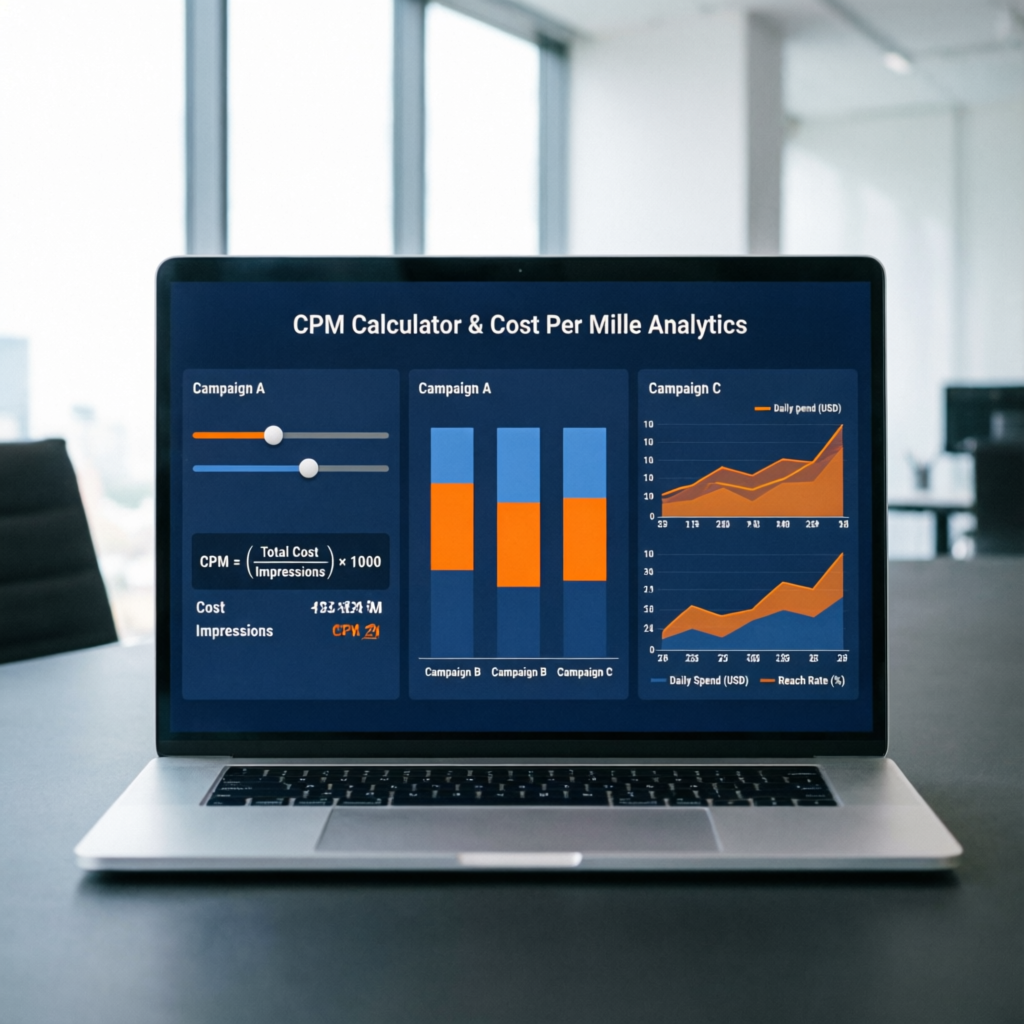
A CPM calculator, frequently referred to as a cost per mille calculator, ad spend estimator, impressions calculator, or media buying calculator, is a specialized software application that automates the algebraic process of determining the efficiency and scale of your digital advertising campaigns. Unlike relying on the opaque, automated dashboards of ad platforms that often obscure the underlying mathematical relationships between spend, reach, and cost, a dynamic CPM calculator allows users to input any two known variables (Total Cost, Total Impressions, or CPM) and instantly derive the third missing financial metric.
Historically, media buyers relied on complex spreadsheet formulas, printed rate cards from traditional print and broadcast media, or manual arithmetic to compute campaign efficiency. The proliferation of digital commerce, the rise of real-time bidding (RTB) exchanges, and the increasing complexity of multi-channel attribution models rendered these manual methods inefficient and highly susceptible to human error. Today, an online CPM calculator provides instantaneous, precise results accessible from any device, eliminating computational errors and ensuring that marketers operate with complete financial transparency. By understanding exactly how much you are paying for every thousand eyes that see your advertisement, you can make informed decisions regarding budget allocation, channel selection, creative optimization, and overall marketing strategy.
The Mathematics Behind CPM Calculations
To fully leverage a CPM calculator, it is beneficial to understand the underlying mathematical formulas that drive its functionality. The logic is rooted in straightforward proportional algebra, yet its application requires careful attention to the scale of the numbers involved, particularly the “mille” (Latin for thousand) component.
1. Calculating CPM (Cost Per Mille)
When you know your total ad spend and the total number of impressions delivered, the formula to find your CPM is:
CPM = (Total Ad Spend / Total Impressions) × 1000
For example, if you spent $500 on a campaign that generated 50,000 impressions, your CPM is ($500 / 50,000) × 1000 = $10.00. This means you paid ten dollars for every thousand times your ad was displayed.
2. Calculating Total Ad Spend (Cost)
When you are planning a campaign and know your target CPM (based on historical benchmarks or publisher rate cards) and your desired reach (impressions), the formula to find your required budget is:
Total Ad Spend = (CPM × Total Impressions) / 1000
If a publisher quotes you a $15 CPM and you want to reach 200,000 users, your required budget is ($15 × 200,000) / 1000 = $3,000.
3. Calculating Total Impressions
When you have a fixed budget and know the prevailing CPM rate for your target audience, the formula to estimate your potential reach is:
Total Impressions = (Total Ad Spend / CPM) × 1000
If you have a $1,000 budget and the average CPM for your demographic is $8.00, your estimated impressions are ($1,000 / 8) × 1000 = 125,000 impressions.
Understanding these formulas empowers users to verify the outputs of any CPM calculator, ensuring complete confidence in the financial data presented and enabling rapid mental math during high-stakes media negotiations.
How to Use This Free CPM Calculator
Our online CPM calculator is engineered for maximum usability, speed, and flexibility. Follow these simple steps to generate your personalized campaign metrics:
1️⃣ Select the Calculation Mode: Choose “Calculate CPM” if you know your spend and impressions. Choose “Calculate Total Ad Spend” if you know your target CPM and desired impressions. Choose “Calculate Total Impressions” if you have a fixed budget and know the CPM rate.
2️⃣ Enter the Known Variables: Input the two values relevant to your selected mode into the designated fields.
3️ Click “Calculate CPM”: Instantly view the missing metric, along with a complete summary of all three variables and a visual breakdown chart.
4️⃣ Analyze and Optimize: Use the results to compare against industry benchmarks, adjust your bidding strategy, or negotiate better rates with publishers.
Real-World Examples of CPM Calculations
To illustrate the practical application of a CPM calculator, consider the following industry-specific scenarios:
A digital marketer runs a Facebook Ads campaign with a total budget of $2,500. The campaign generates 312,500 impressions.
Calculation: CPM = ($2,500 / 312,500) × 1000 = $8.00. The marketer knows their cost per thousand impressions is $8.00, which is slightly below the Facebook average of $9-10, indicating efficient targeting and creative performance.
A media buyer negotiates a direct deal with a premium news website. The publisher quotes a CPM of $25.00. The buyer has a budget of $10,000 for this specific placement.
Calculation: Total Impressions = ($10,000 / 25) × 1000 = 400,000 impressions. The buyer can confidently forecast that their $10,000 investment will yield 400,000 ad views on the premium site.
A brand wants to launch a new product video and aims for 1,000,000 views (impressions). Historical data suggests a YouTube CPM of $12.50 for their niche.
Calculation: Total Ad Spend = ($12.50 × 1,000,000) / 1000 = $12,500. The brand allocates $12,500 to achieve their reach goal, ensuring the campaign is fully funded before launch.
Understanding CPM vs. CPC vs. CPA: Choosing the Right Metric
In digital advertising, CPM is just one of several pricing models. Understanding when to use CPM versus Cost Per Click (CPC) or Cost Per Action/Acquisition (CPA) is critical for campaign success. A CPM calculator helps you model the financial implications of each.
CPM (Cost Per Mille): Best for brand awareness, reach, and visibility campaigns. You pay for impressions regardless of user engagement. It is ideal when your primary goal is to get your message in front of as many relevant eyes as possible. CPM is heavily used in display advertising, video pre-rolls, and social media awareness campaigns.
CPC (Cost Per Click): Best for traffic generation and consideration campaigns. You only pay when a user actively clicks your ad. This shifts the risk of low engagement from the advertiser to the publisher. CPC is the dominant model for search engine marketing (Google Ads) and social media conversion campaigns.
CPA (Cost Per Action): Best for performance and direct response campaigns. You only pay when a user completes a specific, valuable action, such as making a purchase, filling out a lead form, or downloading an app. CPA offers the highest level of risk mitigation for the advertiser but typically commands the highest premiums from publishers.
While a CPM calculator focuses on impression efficiency, sophisticated marketers often calculate the “Effective CPM” (eCPM) for CPC and CPA campaigns to compare the true cost of reach across different pricing models. For example, if your CPC is $1.00 and your Click-Through Rate (CTR) is 2%, your eCPM is ($1.00 / 0.02) × 1000 = $50.00. This allows for apples-to-apples comparison across platforms.
Factors That Influence Your CPM Rates
CPM is not a static number; it fluctuates wildly based on a multitude of market forces, audience characteristics, and campaign settings. Understanding these variables helps you interpret your CPM calculator results and optimize your strategy:
- Industry and Niche: Highly competitive, high-lifetime-value industries like finance, insurance, and B2B software command significantly higher CPMs ($30-$100+) compared to broad consumer goods or entertainment ($2-$10).
- Platform and Channel: Premium video platforms (Connected TV, YouTube) typically have higher CPMs ($15-$40) than standard display banner networks ($1-$5) due to higher engagement and production costs.
- Targeting Specificity: Broad targeting yields lower CPMs due to massive inventory supply. Hyper-specific targeting (e.g., “CEOs of Series B tech companies in San Francisco”) drastically reduces available inventory, driving CPMs up due to scarcity and high demand.
- Geographic Location: Advertising in Tier 1 countries (US, UK, Canada, Australia) is significantly more expensive than in emerging markets. A US-based CPM might be $15, while the same ad in India might cost $2.
- Seasonality and Timing: CPMs spike dramatically during peak shopping seasons (Q4, Black Friday, Cyber Monday) as advertisers compete fiercely for limited consumer attention. January and February typically see the lowest CPMs of the year.
- Ad Format and Creative Quality: High-engagement formats like interactive rich media, 3D ads, or high-definition video command premium CPMs. Furthermore, platforms like Facebook reward high-quality, relevant ads with lower CPMs through their relevance score algorithms.
- Device Type: Mobile CPMs are often lower than desktop CPMs due to higher inventory supply, though mobile video CPMs are rapidly catching up as consumption shifts to smartphones.
Strategies to Lower Your CPM and Maximize ROI
While a low CPM is not the ultimate goal (a low CPM with zero conversions is worthless), optimizing your cost per mille allows you to stretch your budget further and increase your testing velocity. Utilizing a CPM calculator helps you model the impact of these strategies:
- Expand Your Targeting Audiences: If your CPM is prohibitively high, your audience might be too narrow. Broaden your demographic or interest targeting to increase the available inventory pool, which naturally drives down the auction price.
- Improve Ad Relevance and Quality Score: Platforms like Google and Facebook penalize irrelevant ads with higher CPMs. A/B test your creatives, copy, and landing pages to improve your Click-Through Rate (CTR) and engagement metrics. Higher relevance equals lower costs.
- Optimize Bidding Strategies: Switch from aggressive “Target Impression Share” bidding to “Maximize Reach” or “Target CPM” bidding to give the algorithm more flexibility to find cheaper inventory.
- Leverage Lookalike Audiences: Instead of targeting expensive, hyper-specific interests, upload your best customer list and create a 1-3% Lookalike Audience. This often yields high-quality users at a lower CPM than manual interest stacking.
- Adjust Dayparting and Scheduling: If your analytics show that conversions drop off after 8 PM, stop running ads during those expensive evening hours. Concentrating your budget during high-performing windows improves overall efficiency.
- Negotiate Direct Deals: If you are spending significant budget on programmatic open exchanges, consider approaching publishers directly for Private Marketplace (PMP) deals or guaranteed IOs. Direct deals often offer lower, fixed CPMs compared to the open auction.
Common Mistakes When Calculating CPM Manually
Even experienced media buyers make errors when calculating CPM manually or misinterpreting platform data. A dedicated online CPM calculator mitigates these common pitfalls:
- Forgetting the “Per Thousand” Multiplier: The most frequent error is dividing cost by impressions and forgetting to multiply by 1000, resulting in a number that is 1000x too small (e.g., $0.01 instead of $10.00).
- Confusing Impressions with Reach: Impressions count every time an ad is loaded, even if the same user sees it 10 times. Reach counts unique users. CPM is calculated on impressions, not reach. Using reach in the formula will yield an artificially high CPM.
- Ignoring Viewability Metrics: A CPM of $5.00 seems great, but if only 40% of those impressions are actually “viewable” (50% of pixels in view for 1 second), your effective Viewable CPM (vCPM) is actually $12.50. Always factor in viewability when comparing CPMs.
- Not Accounting for Ad Fraud: Invalid traffic (IVT) and bot impressions inflate your impression count, artificially lowering your reported CPM while wasting your budget. Always use third-party verification tools (like Moat or DoubleVerify) to ensure you are paying for human eyes.
- Mixing Gross and Net Costs: When comparing publisher rate cards, ensure you are comparing apples to apples. Some quotes include agency fees, ad server fees, and third-party tracking fees (Gross), while others are just the media cost (Net).
The Future of Programmatic Advertising and CPM Evolution
As the digital advertising ecosystem matures, the traditional CPM model is evolving. The deprecation of third-party cookies, the rise of privacy-first frameworks (like Apple’s ATT and Google’s Privacy Sandbox), and the increasing sophistication of AI-driven bidding algorithms are fundamentally changing how impressions are valued and priced.
We are seeing a shift towards “Outcome-Based CPM” or “Attention-Based CPM,” where the cost is not just tied to the raw impression count, but to the quality of that impression—measured by dwell time, eye-tracking data, or interaction depth. Furthermore, the rise of Retail Media Networks (Amazon, Walmart Connect) is creating new, high-intent CPM environments that blend the reach of display with the conversion power of search. Despite these advancements, the foundational mathematics of the CPM calculator remain the bedrock upon which these complex, next-generation pricing models are built. Understanding the base unit cost is essential for auditing, forecasting, and strategic planning in any era of advertising.
Integrating Marketing Tools with Other Business Utilities
Optimizing your financial and operational workflow often requires a suite of specialized tools. For instance, when preparing promotional materials for your next high-CPM video campaign or updating your media kit for direct publisher negotiations, you might need to optimize visual assets to ensure your landing pages load quickly; utilizing a reliable image converter can compress files without sacrificing quality, directly supporting your conversion rate goals and Quality Score metrics. Similarly, just as a snow day calculator helps schools and businesses anticipate and plan for weather-related operational disruptions and their impact on foot traffic or digital engagement, a CPM calculator allows you to proactively model expected advertising costs across different seasonal demand scenarios and market fluctuations. For niche markets, specialized tools are equally important; a pet calculator hub assists veterinary clinics and pet product brands in estimating care costs and customer acquisition metrics, much like how our tool estimates digital ad spend with precision. Finally, to build a comprehensive financial strategy, combining this CPM calculator with broader smart life calculators can provide a holistic, 360-degree view of your personal or business budget, ensuring every marketing dollar and operational expense is accounted for. For authoritative guidance on digital advertising standards and measurement, you can also refer to the Interactive Advertising Bureau (IAB) resources.
Frequently Asked Questions (FAQs)
Conclusion
A CPM calculator is far more than a simple division tool; it is a fundamental instrument for marketing empowerment and financial optimization. For advertisers, it guarantees transparency, piercing through the veil of complex platform dashboards to reveal the true cost of reach and visibility. For publishers and media owners, it is a critical component of yield management, inventory pricing, and revenue forecasting. By understanding the mathematics, market dynamics, and strategic applications of Cost Per Mille calculations, you can make informed, profitable decisions that maximize your advertising ROI and build long-term brand equity. Bookmark this page to ensure you always have a reliable, accurate, and free CPM estimator at your fingertips, empowering you to take control of your marketing destiny in an increasingly complex digital landscape.
Image Converters • Snow Day Calculators • Pet Calculator Hub • Smart Life Calculators
© 2026 Calculator Tools — Estimates are for educational and planning purposes. Actual ad platform metrics may vary based on real-time auction dynamics, fees, and specific campaign settings.