
Ovulation Calculator
Accurately determine your most fertile days and ovulation date based on your last menstrual period and cycle length. The ultimate free tool for conception and cycle tracking.
Ovulation Calculator
Welcome! I am the Ovulation Calculator, a dedicated digital companion designed to help you understand and track your menstrual cycle with precision. My goal is to provide you with clear, science-based insights into your fertile window, ovulation date, and cycle phases. Whether you are trying to conceive, tracking your cycle for health awareness, or simply curious about your body’s natural rhythms, I’m here to make the complex biology of fertility simple, accessible, and empowering.
The Comprehensive Guide to the Ovulation Calculator: Mastering Your Fertile Window, Cycle Phases, and Reproductive Health
In the intricate landscape of reproductive endocrinology, fertility tracking, and women’s health, understanding the precise mechanics of the menstrual cycle is paramount to achieving your reproductive goals. An ovulation calculator serves as an indispensable digital utility designed to instantly compute your most fertile days and estimated ovulation date based on a sophisticated algorithm incorporating your last menstrual period (LMP) and average cycle length. Whether you are trying to conceive (TTC), tracking your cycle for health awareness, or simply curious about your body’s natural rhythms, utilizing a reliable ovulation estimator guarantees mathematical precision and strategic foresight. This exhaustive guide will explore the physiological, mathematical, and strategic dimensions of ovulation calculations, establishing why this metric is the cornerstone of modern fertility management.
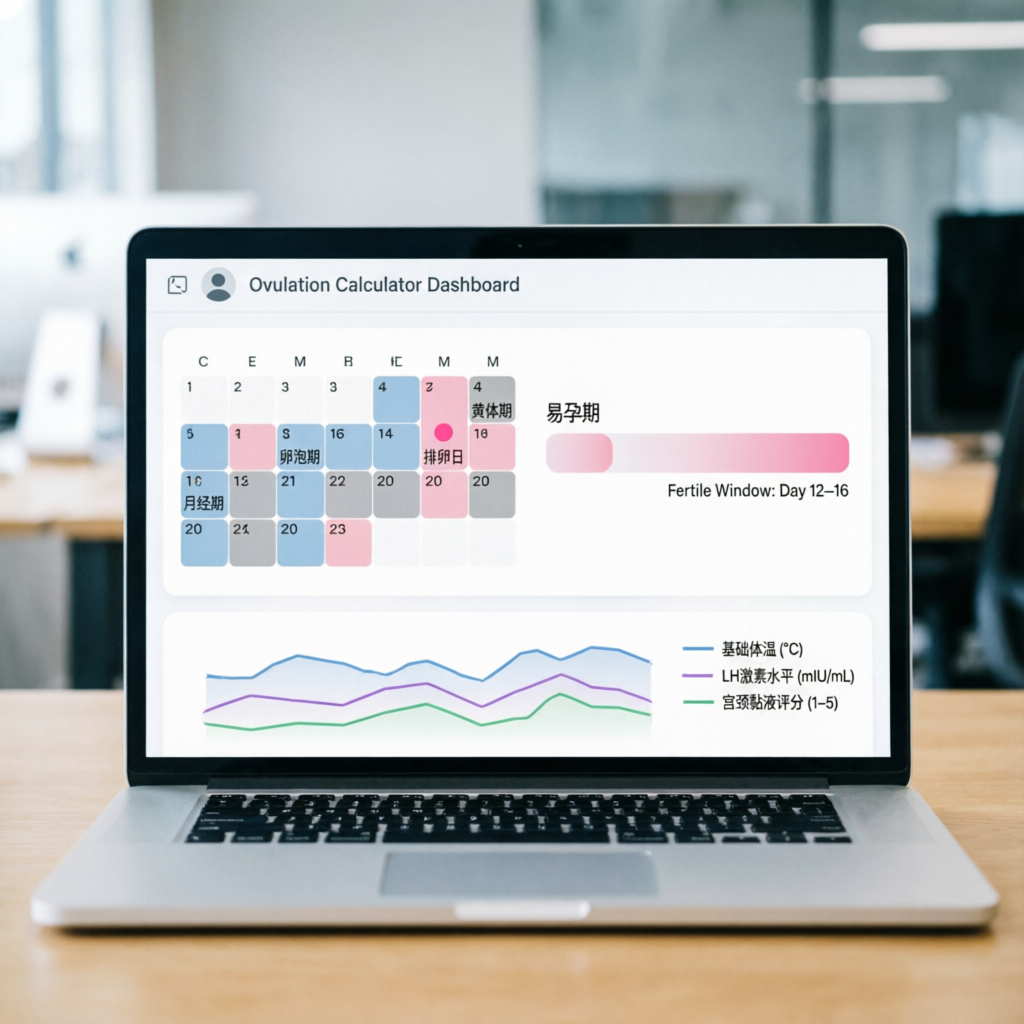
What is Ovulation and Why is Timing Crucial?
Ovulation is the process in which a mature egg is released from the ovary into the fallopian tube, where it can be fertilized by sperm. This event typically occurs once per menstrual cycle, roughly in the middle of the cycle. The egg survives for only 12 to 24 hours after release, making the timing of intercourse critical for conception.
However, the “fertile window” is actually about 6 days long. This is because sperm can survive in the female reproductive tract for up to 5 days under optimal conditions (fertile cervical mucus). Therefore, having intercourse in the 5 days leading up to ovulation, as well as on the day of ovulation itself, maximizes the chances of sperm being present when the egg is released. Our ovulation calculator pinpoints this exact window, giving you the best possible data for family planning.
The Science Behind the Calculation: Cycle Phases
The logic driving our ovulation calculator is rooted in decades of reproductive endocrinology research. The menstrual cycle is divided into distinct phases, each governed by specific hormonal fluctuations:
1. The Follicular Phase
This phase begins on the first day of your period (LMP) and ends at ovulation. During this time, the pituitary gland releases Follicle-Stimulating Hormone (FSH), which stimulates the ovaries to prepare several follicles. One dominant follicle matures and produces estrogen, which thickens the uterine lining. The length of this phase varies significantly between women and even from cycle to cycle.
2. Ovulation
A surge in Luteinizing Hormone (LH) triggers the release of the mature egg. This LH surge typically occurs 24-36 hours before ovulation. Ovulation itself is the shortest phase, lasting only about 24 hours.
3. The Luteal Phase
After ovulation, the ruptured follicle transforms into the corpus luteum, which secretes progesterone to maintain the uterine lining for potential implantation. The luteal phase is remarkably consistent for most women, typically lasting between 12 and 16 days (average 14 days). If pregnancy does not occur, the corpus luteum degenerates, progesterone levels drop, and menstruation begins.
How to Use This Free Ovulation Calculator
Our online ovulation calculator is engineered for maximum usability, speed, and accuracy. Follow these simple steps to generate your personalized fertility timeline:
1️⃣ Enter the First Day of Your LMP: Input the exact date your last menstrual period began. This is the anchor point for all calculations.
2️⃣ Enter Your Average Cycle Length: Input the typical number of days between the start of one period and the start of the next. The default is 28 days, but adjust this if your cycles are shorter or longer.
3️⃣ (Optional) Enter Luteal Phase Length: The luteal phase is the time between ovulation and your next period. The default is 14 days, which is standard for most women. If you track your basal body temperature (BBT) and know your specific luteal phase length, enter it here for higher precision.
4️⃣ Click “Calculate Ovulation”: Instantly view your estimated ovulation date, fertile window, next period date, current cycle day, and a visual chart of your cycle phases.
Real-World Examples of Ovulation Calculations
To illustrate the practical application of an ovulation calculator, consider the following scenarios representing different cycle lengths:
A woman with a regular 28-day cycle had her LMP start on June 1, 2026.
Calculation: Next Period = June 1 + 28 days = June 29. Ovulation = June 29 – 14 days = June 15.
Fertile Window: June 10 to June 15 (5 days before + day of ovulation).
Insight: Her most fertile days are June 10-15. If she is trying to conceive, she should aim to have intercourse every other day during this window.
A woman with a longer 32-day cycle had her LMP start on June 1, 2026.
Calculation: Next Period = June 1 + 32 days = July 3. Ovulation = July 3 – 14 days = June 19.
Fertile Window: June 14 to June 19.
Insight: Because her cycles are longer, her follicular phase is longer, pushing ovulation later in the cycle. The calculator automatically adjusts for this, ensuring her fertile window is accurately placed.
Signs and Symptoms of Ovulation
While our calculator provides a highly accurate estimate based on mathematical models, your body also gives physical cues that ovulation is approaching. Tracking these signs alongside the calculator can further refine your fertile window:
- Cervical Mucus Changes: As ovulation approaches, estrogen levels rise, causing cervical mucus to become clear, stretchy, and slippery (often compared to raw egg whites). This “fertile mucus” helps sperm survive and swim toward the egg.
- Basal Body Temperature (BBT) Shift: Your resting body temperature rises slightly (about 0.5-1°F) after ovulation due to increased progesterone. Tracking BBT daily can confirm that ovulation has occurred, though it cannot predict it in advance.
- Ovulation Pain (Mittelschmerz): Some women experience a mild, one-sided lower abdominal pain or twinge when the egg is released. This typically lasts a few minutes to a few hours.
- LH Surge (Ovulation Predictor Kits): Home ovulation predictor kits (OPKs) detect the LH surge in your urine, which occurs 24-36 hours before ovulation. This is the most reliable at-home method for predicting ovulation.
Factors That Can Affect Ovulation
While our calculator provides a reliable estimate for women with regular cycles, several factors can cause ovulation to occur earlier or later than predicted:
- Stress: High levels of physical or emotional stress can disrupt the hypothalamic-pituitary-ovarian axis, delaying or even preventing ovulation.
- Illness: Severe illness or infection can temporarily shift your cycle, as the body prioritizes survival over reproduction.
- Weight Changes: Significant weight loss or gain can affect hormone production, particularly leptin and insulin, which play roles in regulating ovulation.
- Polycystic Ovary Syndrome (PCOS): Women with PCOS often have irregular or absent ovulation due to hormonal imbalances. In such cases, calculator estimates may be less accurate, and medical guidance is recommended.
Integrating Fertility Tools with Other Health Utilities
Optimizing your health, wellness, and operational workflow often requires a suite of specialized tools. For instance, when preparing promotional materials for your fertility clinic, prenatal yoga studio, or a major women’s health awareness campaign, you might need to optimize visual assets to ensure your landing pages load quickly; utilizing a reliable image converter can compress files without sacrificing quality, directly supporting your client acquisition goals and user experience. Similarly, just as a snow day calculator helps schools and businesses anticipate and plan for weather-related operational disruptions and their impact on facility bookings or event schedules, an ovulation calculator allows you to proactively model fertility milestones and prenatal care schedules across different patient demographics. For niche markets, specialized tools are equally important; a pet calculator hub assists veterinary clinics and animal care businesses in estimating nutritional needs and gestation periods for animals, much like how our tool estimates human reproductive timelines with precision. Finally, to build a comprehensive wellness strategy, combining this ovulation calculator with broader smart life calculators can provide a holistic, 360-degree view of your personal or business health initiatives, ensuring every metric, goal, and lifestyle intervention is meticulously accounted for.
Frequently Asked Questions (FAQs)
Conclusion
An ovulation calculator is far more than a simple calendar tool; it is a fundamental instrument for reproductive empowerment, evidence-based fertility management, and proactive health tracking. For individuals trying to conceive, it guarantees clarity, piercing through the confusion of cycle variability to reveal an objective, actionable metric of true fertility. For health-conscious women, it is a critical component of cycle awareness, hormonal health monitoring, and longitudinal progress tracking. By understanding the physiological, mathematical, and strategic dimensions of ovulation calculations, you can make informed, resilient decisions that protect your long-term reproductive health, optimize your chances of conception, and steadily build a foundation for a vibrant, balanced life. Bookmark this page to ensure you always have a reliable, accurate, and free ovulation estimator at your fingertips, empowering you to take control of your fertility journey with confidence, precision, and scientific clarity.
Image Converters • Snow Day Calculators • Pet Calculator Hub • Smart Life Calculators
© 2026 Calculator Tools — Estimates are for educational and informational purposes only. This tool does not constitute medical or reproductive advice. Always consult a qualified healthcare professional for personalized guidance on fertility and reproductive health, especially if you have pre-existing conditions like PCOS.