
UV Index Exposure Calculator
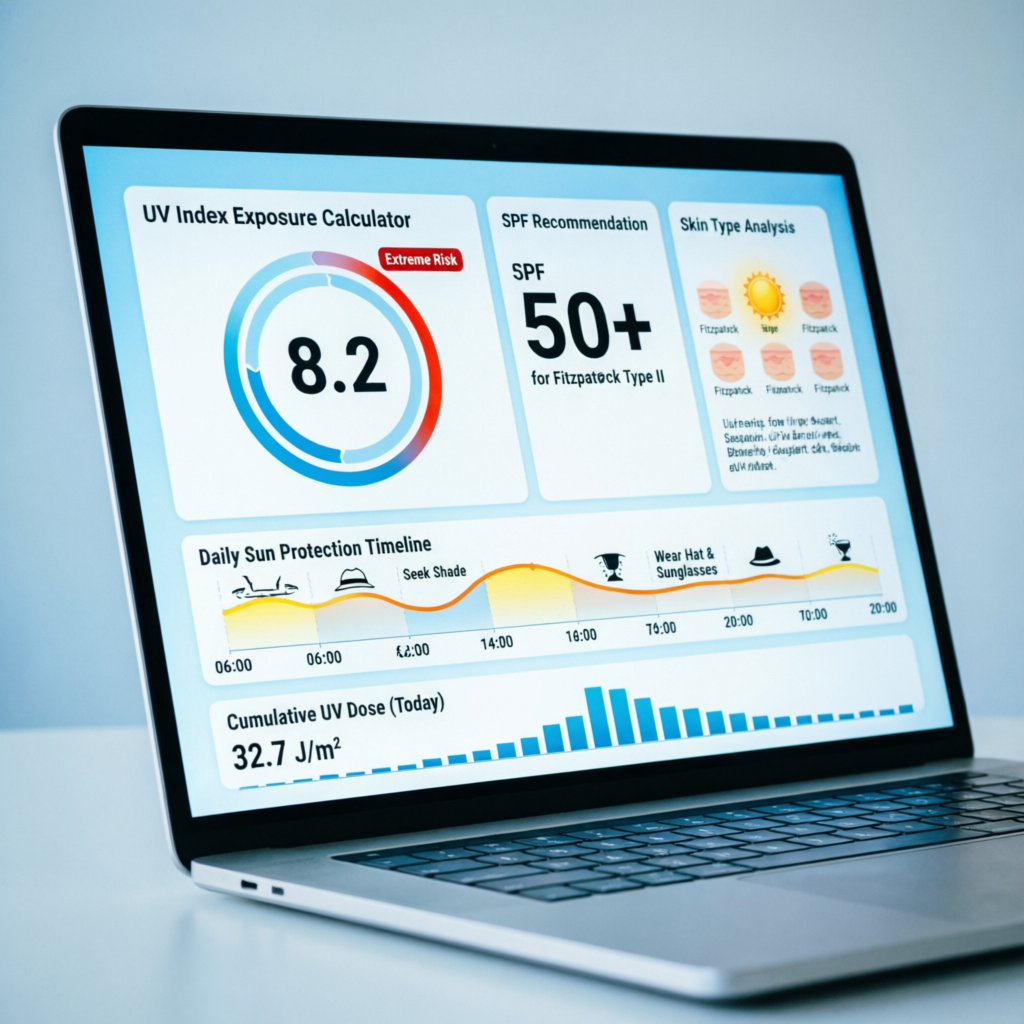
Accurately determine your safe sun exposure time based on your skin type, SPF, and current UV levels. The ultimate free tool for sun protection and skin health.
UV Index Exposure Calculator
Welcome! I am the UV Index Exposure Calculator, a dedicated digital tool designed to help you understand your safe sun exposure limits and protect your skin from harmful ultraviolet radiation. My goal is to provide you with clear, science-based insights into your personal burn risk, recommended SPF levels, and optimal sun protection strategies. Whether you are planning a beach day, working outdoors, or simply curious about how the sun affects your specific skin type, I’m here to make the complex science of photobiology simple, accessible, and actionable.
The Comprehensive Guide to the UV Index Exposure Calculator: Mastering Sun Protection, Skin Health, and Photobiology
In the critical landscape of dermatology, preventive medicine, and long-term skin health, understanding the precise mechanics of ultraviolet (UV) radiation exposure is paramount to preventing sunburn, premature aging, and skin cancer. A UV index exposure calculator serves as an indispensable digital utility designed to instantly compute your safe sun exposure time based on a sophisticated algorithm incorporating the Fitzpatrick skin typing scale, sunscreen SPF efficacy, and real-time UV index levels. Whether you are a beachgoer planning a summer day, an outdoor athlete managing cumulative sun damage, a parent protecting a child’s delicate skin, or simply someone curious about the sun’s impact on your specific biology, utilizing a reliable UV estimator guarantees mathematical precision and strategic foresight. This exhaustive guide will explore the physiological, mathematical, and strategic dimensions of UV exposure calculations, establishing why this metric is the cornerstone of modern dermatological health.
What is the UV Index and Why Does it Matter?
The UV Index (UVI) is an international standard measurement of the strength of sunburn-producing ultraviolet radiation at a particular place and time. Developed by the World Health Organization (WHO) and the World Meteorological Organization (WMO), the scale runs from 0 (minimal) to 11+ (extreme). Unlike temperature, which you can feel, UV radiation is invisible and its intensity is not directly related to heat. You can get severely sunburned on a cool, cloudy day if the UV index is high.
Understanding the UV index is crucial because it directly correlates with the risk of skin damage. Higher UV index values mean greater potential for skin and eye damage, and less time it takes for harm to occur. Our calculator translates this abstract number into a concrete, personalized metric: exactly how many minutes you can safely spend in the sun before burning, based on your unique biological profile.
The Science Behind the Calculation: The Fitzpatrick Scale
The logic driving our UV index exposure calculator is rooted in decades of dermatological research, most notably the Fitzpatrick Skin Typing Scale. Developed in 1975 by Harvard dermatologist Thomas B. Fitzpatrick, this scale classifies human skin color and its response to UV radiation into six distinct types:
- Type I: Very fair skin, always burns, never tans. (Base burn time at UV 1: ~10 minutes)
- Type II: Fair skin, usually burns, tans minimally. (Base burn time at UV 1: ~20 minutes)
- Type III: Medium skin, sometimes burns, tans gradually. (Base burn time at UV 1: ~30 minutes)
- Type IV: Olive skin, rarely burns, tans well. (Base burn time at UV 1: ~40 minutes)
- Type V: Brown skin, very rarely burns, tans darkly. (Base burn time at UV 1: ~60 minutes)
- Type VI: Dark brown/black skin, never burns. (Base burn time at UV 1: ~90 minutes)
This scale is the foundation of our calculator. By identifying your Fitzpatrick type, we establish your baseline vulnerability to UV radiation, which is then adjusted for environmental factors and protective measures.
The Mathematics of Sun Exposure and SPF
Calculating safe sun exposure involves a multi-variable equation that balances your biological vulnerability against environmental intensity and artificial protection:
Step 1: Establish Base Burn Time
Using the Fitzpatrick scale, we determine how many minutes your skin can tolerate direct sunlight at a UV index of 1 before erythema (redness/burning) occurs.
Step 2: Adjust for Current UV Intensity
The current UV index acts as a multiplier of radiation intensity. We divide your base burn time by the current UV index to find your unprotected burn time in current conditions: Unprotected Time = Base Time / UV Index.
Step 3: Apply SPF Protection
Sun Protection Factor (SPF) theoretically multiplies your safe exposure time. An SPF 30 means it should take 30 times longer to burn than with no protection: Protected Time = Unprotected Time × SPF. However, real-world application is rarely perfect, so our calculator provides a conservative estimate.
Step 4: Environmental Modifiers
Being in the shade reduces UV exposure by approximately 50-75%, effectively doubling or tripling your safe time. Our calculator applies these environmental adjustments to provide a realistic, actionable result.
How to Use This Free UV Index Exposure Calculator
Our online UV index exposure calculator is engineered for maximum usability, speed, and accuracy. Follow these simple steps to generate your personalized sun protection analysis:
1️⃣ Check Your Local UV Index: Find the current UV index for your location via a weather app or website (e.g., EPA SunWise, Weather.com).
2️ Select Your Fitzpatrick Skin Type: Honestly assess your skin’s natural reaction to sun exposure without sunscreen.
3️⃣ Choose Your Sunscreen SPF: Select the SPF level of the sunscreen you plan to use, or “None” to see your unprotected risk.
4️⃣ Select Your Activity/Environment: Indicate whether you will be in direct sunlight, in the shade, or indoors near a window.
5️⃣ Click “Calculate Safe Exposure”: Instantly view your safe exposure time, burn risk level, recommended SPF, and a visual chart of your protection breakdown.
Real-World Examples of UV Exposure Calculations
To illustrate the practical application of a UV index exposure calculator, consider the following scenarios representing different skin types and conditions:
A Type II (fair skin) individual plans to spend the day at the beach. The UV index is 9 (Very High). They apply SPF 30 sunscreen.
Calculation: Base Time (20 mins) / UV Index (9) × SPF (30) = ~66 minutes.
Insight: Despite using SPF 30, their safe exposure time in direct sun at UV 9 is only about 1 hour. They must reapply sunscreen every 80 minutes (especially after swimming) and seek shade during peak hours (10 AM – 4 PM) to prevent cumulative damage.
A Type III (medium skin) individual is having a picnic in the shade. The UV index is 5 (Moderate). They are not wearing sunscreen.
Calculation: Base Time (30 mins) / UV Index (5) = 6 minutes unprotected. In the shade (50% reduction), safe time extends to ~12 minutes.
Insight: Even in the shade, UV radiation reflects off surfaces (grass, sand, water) and scatters in the atmosphere. Without sunscreen, a Type III individual can still burn in the shade during moderate UV conditions. Applying SPF 30 would extend their safe shade time to over 6 hours.
The Hidden Dangers: UVA vs. UVB Radiation
Not all UV radiation is created equal. The sun emits two primary types of UV rays that reach the earth’s surface, each with distinct biological impacts:
- UVB Rays (290-320 nm): These are the primary cause of sunburn and play a key role in the development of skin cancer. They are most intense between 10 AM and 4 PM and are partially blocked by glass. SPF ratings primarily measure protection against UVB.
- UVA Rays (320-400 nm): These rays penetrate deeper into the skin, causing premature aging (wrinkles, sun spots) and contributing to skin cancer. They are present with relatively equal intensity during all daylight hours and can penetrate clouds and glass. Look for “Broad Spectrum” sunscreen to ensure UVA protection.
Our calculator accounts for the total UV index, which includes both UVA and UVB contributions, providing a comprehensive view of your exposure risk.
Strategies for Optimal Sun Protection
Knowing your safe exposure time is only the first step; implementing a comprehensive sun protection strategy is crucial for long-term skin health. Dermatologists recommend the “Slip, Slop, Slap, Seek, Slide” approach:
- Slip on protective clothing: Wear long-sleeved, tightly woven fabrics. Dark colors and synthetic materials like polyester offer better UV protection than light cotton.
- Slop on sunscreen: Apply a broad-spectrum, water-resistant sunscreen with SPF 30 or higher. Use approximately 1 ounce (a shot glass full) for full body coverage, and reapply every 2 hours or after swimming/sweating.
- Slap on a hat: Wear a wide-brimmed hat that shades your face, ears, and neck. Baseball caps leave the ears and neck vulnerable.
- Seek shade: Stay under umbrellas, trees, or other shelters, especially during peak UV hours (10 AM to 4 PM).
- Slide on sunglasses: Wear sunglasses that block 99-100% of both UVA and UVB rays to protect your eyes and the delicate skin around them.
Integrating Health Tools with Other Business Utilities
Optimizing your health, wellness, and operational workflow often requires a suite of specialized tools. For instance, when preparing promotional materials for your dermatology clinic, outdoor recreation business, or a major skin cancer awareness campaign, you might need to optimize visual assets to ensure your landing pages load quickly; utilizing a reliable image converter can compress files without sacrificing quality, directly supporting your client acquisition goals and user experience. Similarly, just as a snow day calculator helps schools and businesses anticipate and plan for weather-related operational disruptions and their impact on facility bookings or event schedules, a UV index exposure calculator allows you to proactively model sun safety protocols and outdoor activity scheduling across different demographics and geographic regions. For niche markets, specialized tools are equally important; a pet calculator hub assists veterinary clinics and animal care businesses in estimating nutritional needs and health metrics for pets, much like how our tool estimates human dermatological risk with precision. Finally, to build a comprehensive wellness strategy, combining this UV calculator with broader smart life calculators can provide a holistic, 360-degree view of your personal or business health initiatives, ensuring every metric, goal, and lifestyle intervention is meticulously accounted for.
Frequently Asked Questions (FAQs)
Conclusion
A UV index exposure calculator is far more than a simple timer; it is a fundamental instrument for dermatological empowerment, evidence-based skin health management, and proactive cancer prevention. For individuals, it guarantees clarity, piercing through the confusion of sunscreen marketing and weather reports to reveal an objective, actionable metric of true sun safety. For healthcare professionals and outdoor educators, it is a critical component of patient education, risk assessment, and longitudinal health monitoring. By understanding the Fitzpatrick scale, the mathematics of SPF, and the strategic applications of UV exposure calculations, you can make informed, resilient decisions that protect your long-term skin health, prevent premature aging, and steadily build a foundation for a vibrant, safe life outdoors. Bookmark this page to ensure you always have a reliable, accurate, and free UV estimator at your fingertips, empowering you to take control of your sun exposure with confidence, precision, and scientific clarity.
Image Converters • Snow Day Calculators • Pet Calculator Hub • Smart Life Calculators
© 2026 Calculator Tools — Estimates are for educational and informational purposes only. This tool does not constitute medical or dermatological advice. Always consult a qualified healthcare professional or dermatologist for personalized guidance on skin health and sun protection, especially if you have a history of skin cancer or photosensitivity.